
Fireplace in the Middle of the Room: Ideas for High Ceilings and Open-Plan Homes
What a fireplace in the middle of the room is called, how to place one, where the TV goes, and why it suits high ceilings and open-plan New Zealand homes.
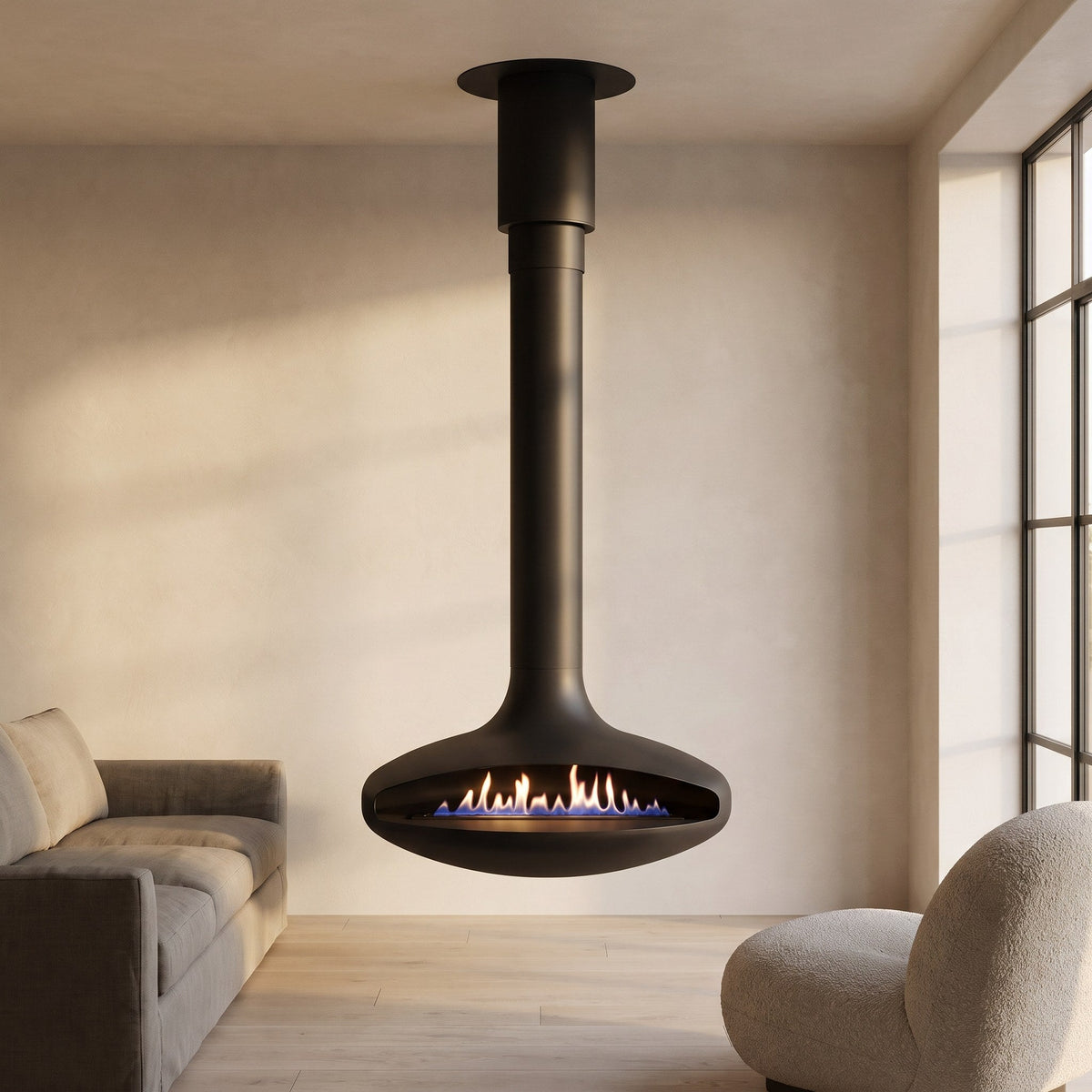
A fireplace in the middle of the room is usually called a suspended, hanging or central fireplace. It hangs from the ceiling on its flue, so it can sit anywhere in the room rather than against a wall. In an open-plan New Zealand home with a high or raked ceiling, it gives the space a centre that a wall fire never can.
What is a fireplace in the middle of the room called?
The common names are suspended fireplace, hanging fireplace, ceiling-mounted fireplace, floating fireplace and central fireplace. Some suspended fires rotate, so they can face the sofa in winter and the dining table at dinner. A freestanding fire on a pedestal gives a similar island effect from the floor.
Fireplace ideas for high ceilings
High ceilings are where suspended fires make the most sense. A tall void can make a wall fire feel small; a fire hung in the space fills the volume and draws the eye down to living height.
- Use the flue as a line. On a high stud, the flue becomes a vertical element in its own right. The Silo and Orbit extend that line.
- Scale the fire to the room. The Curve 120 holds its own in a large double-height space. The Sphere suits a more compact living area.
- Raked ceilings are fine. An angled ceiling fitting handles pitched and raked ceilings.
How to place a fireplace in the middle of the room
- Give it space. Keep clear floor around the fire and keep furniture and curtains back from the firebox.
- Anchor the seating. Place the sofa so it faces the fire, with the fire between the seating and a solid wall or the view, not in a walkway.
- Mind the windows. A fire in front of a large window competes with the view. Sitting it off to one side lets both work.
- Check the ceiling above. The fixing needs framing that can carry 350 kg, so confirm the position with your builder before you commit.
- Respect the room size. Each bioethanol burner has a minimum room volume: 80 m³ for the Sphere, 90 m³ for the Curve 90, Orbit and Silo, and 110 m³ for the Curve 120.
Use materials to support the fire
Neutral stone, timber, plaster, concrete and dark metal all work with a suspended fire. Match or contrast the finish on purpose: black powdercoat and corten sit quietly against timber and plaster, while brushed or polished stainless lifts a darker room. Give the fire a clear visual zone and keep oversized furniture and competing features away from it.
Where does the TV go with a central fireplace?
This is the main advantage of a suspended fire. Because the fire is not on the TV wall, you avoid the classic problem of a TV mounted too high above a mantel. Put the TV on a side wall at seated eye height and let the fire sit in the room, or angle the seating so the fire and the TV each have their own zone.
Which fuel suits an open-plan home?
Bioethanol is the most flexible because it needs no exhaust flue to the roof or gas line. Gas suits homes that want controllable heat. Wood suits rural properties where consent and clean air rules allow it. Our fuel guide compares all four.
See the forms in person at our Takapuna showroom, read about installing a suspended fireplace, or browse the suspended fireplace range.